
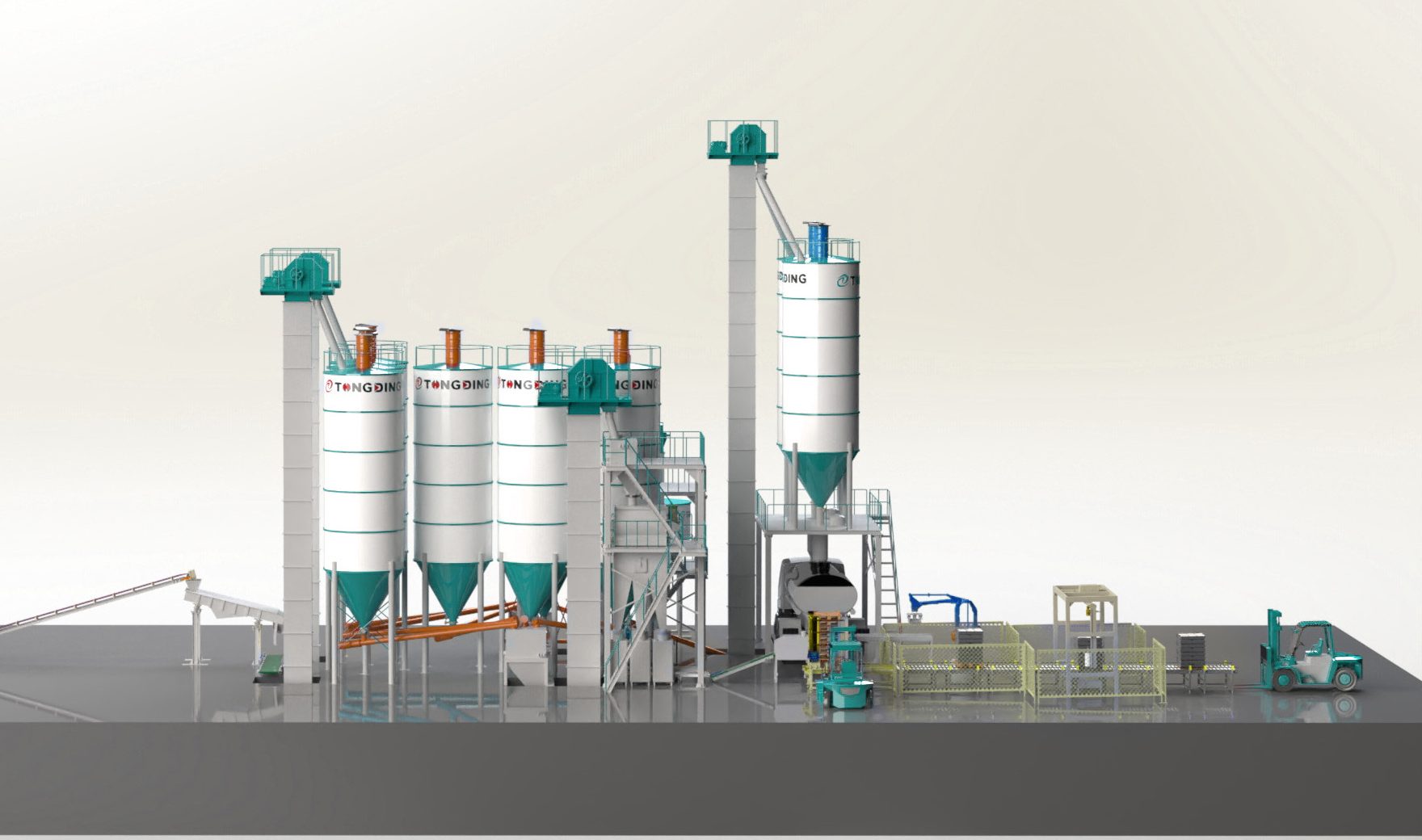
How Is Tile Adhesive Manufactured in a Modern Automatic Production Line?
Tile adhesive has gradually replaced traditional cement mortar as the preferred bonding material for ceramic tiles, porcelain tiles, natural stone, and large-format tiles. Thanks to its excellent bonding strength, flexibility, water resistance, and long service life, tile adhesive is now widely used in residential, commercial, and industrial construction projects worldwide.
As global demand for dry mix construction materials continues to grow, more manufacturers are investing in modern Tile Adhesive Production Lines to improve production efficiency, reduce labor costs, and ensure consistent product quality.
Unlike conventional mortar mixing, a modern tile adhesive manufacturing plant integrates multiple automated systems—including raw material storage, sand drying, automatic batching, micro-additive dosing, high-efficiency mixing, packaging, and PLC intelligent control—into one continuous production process.
Whether you are planning to build a new tile adhesive factory or expand an existing dry mortar plant, understanding the complete manufacturing process is essential before selecting equipment or investing in a production line.
- What a Tile Adhesive Production Line is
- Which products can be manufactured on one production line
- The complete tile adhesive manufacturing process
- Raw materials and equipment required
- How PLC automation improves production efficiency
- How to choose the right production capacity for your factory
Related Product: Explore our Tile Adhesive Production Line for complete equipment specifications, plant layouts, and turnkey project solutions.
What Is a Tile Adhesive Production Line?
A Tile Adhesive Production Line is a complete dry mix manufacturing system designed to produce cement-based tile adhesives and other powdered building materials through automated batching, mixing, conveying, and packaging.
Instead of manually weighing and mixing raw materials, the production line automatically controls every stage of production, ensuring high accuracy, consistent quality, and efficient operation.
Typical equipment includes:
- Raw material storage silos
- Sand drying system
- Vibrating screening system
- Automatic weighing and batching
- Micro-additive dosing system
- Twin-shaft gravity-free mixer
- Finished product storage hopper
- Automatic packing machine
- PLC control system
Depending on production capacity and factory requirements, the line can be configured as:
- Simple Type Plant (5–10 TPH)
- Step-Type Plant (10–30 TPH)
- Tower-Type Plant (30–100 TPH+)
Modern production lines can operate almost entirely automatically, allowing only a few operators to supervise the entire manufacturing process.
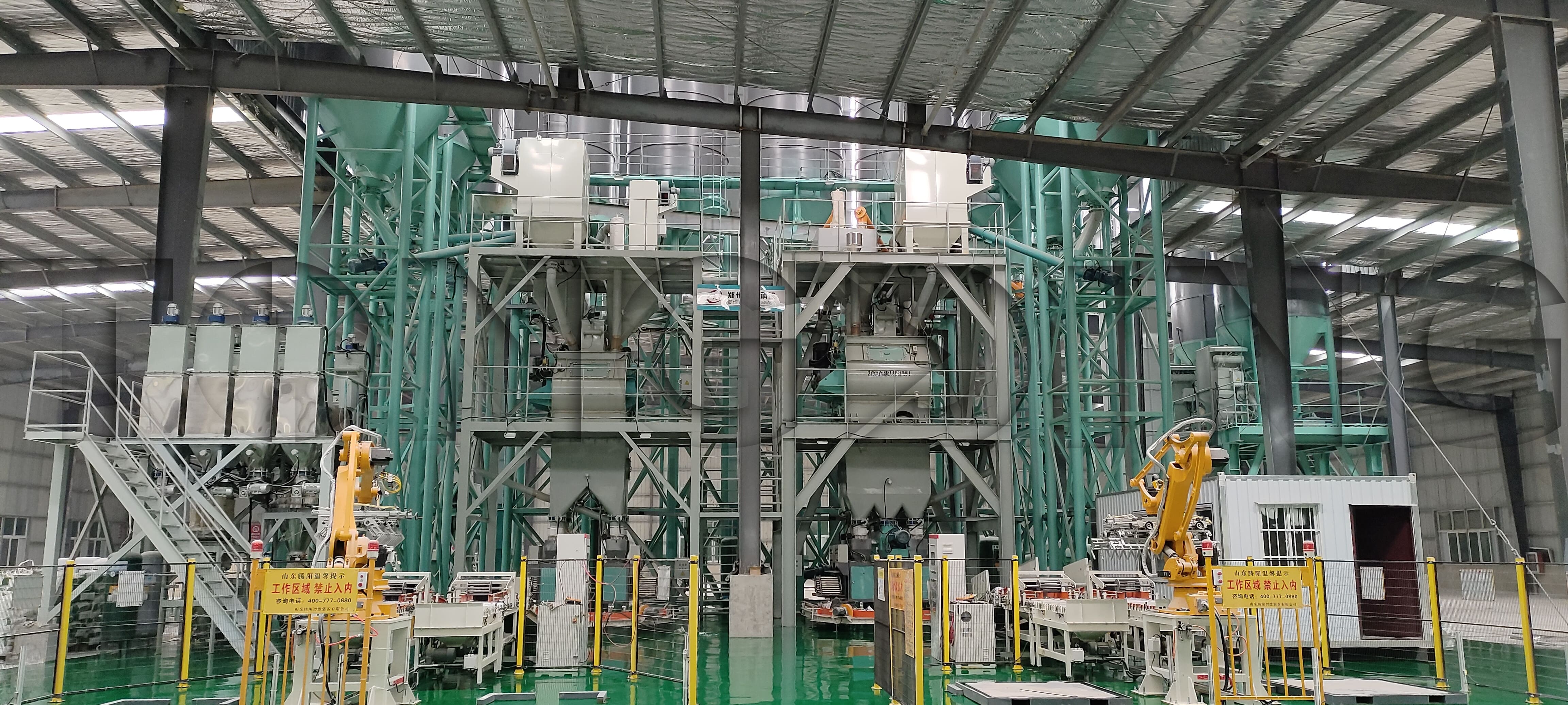
Why Is Tile Adhesive Replacing Traditional Cement Mortar?
Traditional cement mortar relies solely on cement and sand for bonding. While inexpensive, it suffers from poor flexibility, low adhesion, cracking, and water penetration.
Modern tile adhesive contains carefully controlled proportions of cement, graded aggregates, mineral fillers, and polymer additives, resulting in significantly improved performance.
| Traditional Cement Mortar | Tile Adhesive |
|---|---|
| Lower bonding strength | High bonding strength |
| Thick application | Thin-bed application |
| Poor flexibility | Excellent flexibility |
| Higher material consumption | Lower material consumption |
| Easy cracking | Crack-resistant |
| Manual mixing | Factory-controlled quality |
These advantages explain why tile adhesive has become the standard installation material in most modern construction projects.
What Products Can One Tile Adhesive Production Line Produce?
One of the biggest advantages of a modern production line is its flexibility.
By simply changing the production formula stored in the PLC control system, manufacturers can produce multiple dry mix products on the same equipment without replacing the production line.
Typical products include:
- Standard Tile Adhesives – C1, C2, C2TE, wall tile, floor tile, porcelain tile, large format tile, thin set mortar
- Dry Mix Mortars – Masonry mortar, cement plaster, repair mortar, waterproof mortar, dry mix mortar, polymer modified mortar
- Decorative Finishing Materials – Wall putty, skim coat, gypsum plaster, self-leveling mortar
- Specialty Construction Products – AAC block adhesive, tile grout, polymer cement mortar
This flexibility significantly increases equipment utilization and allows manufacturers to respond quickly to changing market demand.
For many investors, this means one production line can support multiple product categories, reducing overall investment costs while increasing profitability.
Industries That Use Tile Adhesive Production Lines
A tile adhesive manufacturing plant serves a wide range of construction material manufacturers.
Typical customers include:
- Dry mix mortar manufacturers
- Building material factories
- Ceramic tile adhesive manufacturers
- Construction chemical companies
- Cement product manufacturers
- Ready-mix material suppliers
- OEM & ODM construction material producers
Many international investors also build turnkey factories to supply local markets in rapidly growing regions such as Africa, Middle East, Southeast Asia, and South America.
As construction activities continue to expand globally, demand for high-quality dry mix products continues to rise.
Why More Investors Choose Automatic Tile Adhesive Production Lines
Compared with semi-automatic production, fully automatic systems provide significant operational advantages.
Key benefits include:
-
- Higher Production Efficiency – Automatic batching, conveying, and packaging eliminate manual interruptions and increase continuous production capacity.
- Consistent Product Quality – PLC-controlled weighing systems maintain highly accurate material proportions, reducing quality fluctuations between batches.
- Lower Labor Costs – A fully automatic production line can usually be operated by only a few workers, dramatically reducing labor expenses.
- Flexible Formula Management – Operators can quickly switch between multiple production recipes, allowing one line to manufacture different products efficiently.
- Easier Maintenance – Modern modular equipment simplifies inspection, maintenance, and future upgrades.
Typical Workflow of a Modern Tile Adhesive Plant
The manufacturing process generally follows the sequence below:
Each stage plays a critical role in ensuring the final product meets strict quality standards.
In the following sections, we will explain every step in detail, including the equipment involved, operating principles, quality control points, and engineering considerations.
Continue Reading
In Part 2, we’ll explore:
- Raw materials required for tile adhesive manufacturing
- The role of cement, sand, fillers, and polymer additives
- Why sand drying is critical
- How automatic batching ensures consistent quality
- Common production mistakes and how modern production lines eliminate them
Tile Council of North America (TCNA) — Tile installation standards and best practices.
CEMBUREAU — European cement industry resources.
ASTM International — International standards related to construction materials.