How Does a Double Shaft Gravity-Free Mixer Work? Understanding the Working Principle Behind High-Uniformity Powder Mixing
How Does a Double Shaft Gravity-Free Mixer Work?
Understanding the Working Principle Behind High-Uniformity Powder Mixing
In modern dry mortar production, mixing quality directly affects the performance of the final product. Whether manufacturing tile adhesive, wall putty, self-leveling mortar, or dry mix mortar, achieving a uniform mixture is critical for product consistency and customer satisfaction.
Among various industrial mixing technologies, the Double Shaft Gravity-Free Mixer has become one of the most widely used solutions due to its exceptional mixing efficiency and uniformity.
But how does a double shaft gravity-free mixer actually work?
This article explains the complete working principle, internal structure, mixing process, and advantages of this high-performance powder mixing equipment.
What Is a Double Shaft Gravity-Free Mixer?
A Double Shaft Gravity-Free Mixer, also known as a:
- Twin Shaft Paddle Mixer
- Weightless Mixer
- Non-Gravity Mixer
- Double Shaft Powder Mixer
is a batch mixing machine designed for high-speed and high-uniformity mixing of powders, granules, fibers, and additives.
It is widely used in:
- Dry Mortar Production Lines
- Tile Adhesive Plants
- Wall Putty Manufacturing
- Self-Leveling Mortar Plants
- Gypsum Powder Processing
- Chemical Powder Production
- Fertilizer Manufacturing
Related Product:
Internal Link: Double Shaft Gravity-Free Mixer
Why Is It Called a Gravity-Free Mixer?
The term “gravity-free” does not mean gravity disappears.
Instead, it refers to a temporary weightless mixing zone created inside the mixer.
When materials are rapidly thrown upward by specially designed paddles, the particles become suspended in the air for a short period.
During this moment:
- Particle movement is no longer dominated by gravity.
- Materials move freely in multiple directions.
- Different particle sizes mix more uniformly.
This temporary suspension state is called the gravity-free zone or weightless mixing state.
It is the core reason why this mixer achieves much higher mixing uniformity than conventional equipment.
The Core Working Principle of a Double Shaft Gravity-Free Mixer
Counter-Rotating Twin Shafts
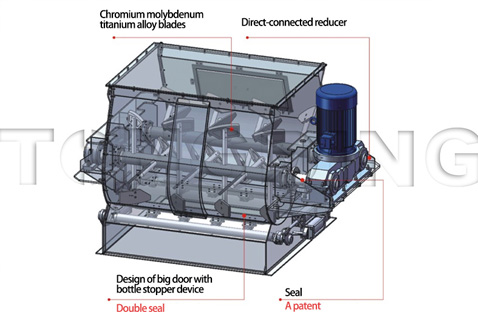
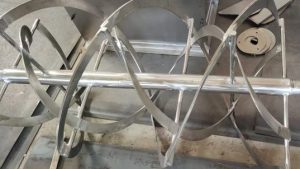
The mixer contains two horizontal shafts mounted parallel to each other. These shafts rotate in opposite directions at synchronized speeds.
As they rotate:
- Material is lifted continuously.
- Material is thrown upward.
- Material is dispersed across the mixing chamber.
This creates strong convection and rapid material circulation.
Special Paddle Design
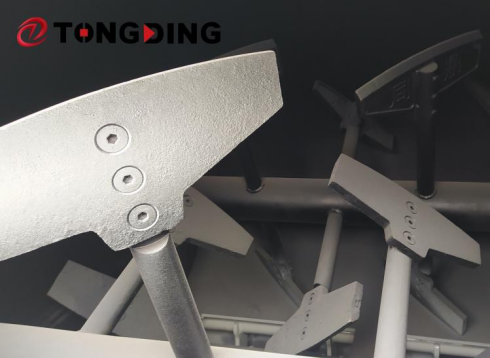
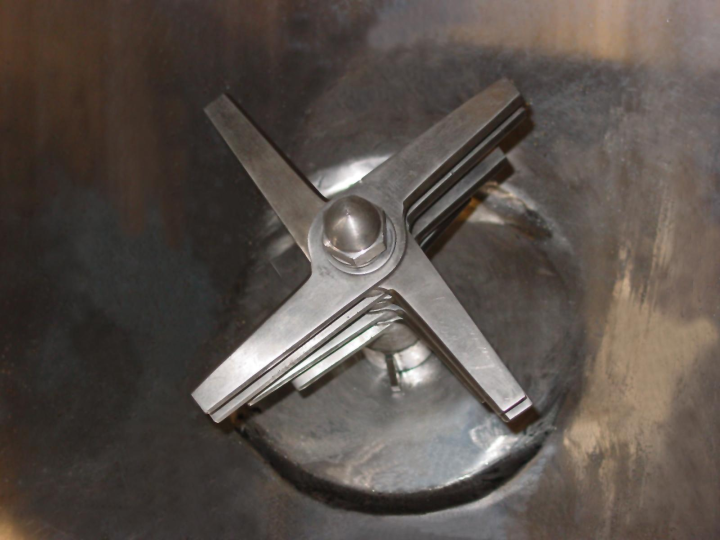
Each shaft is equipped with multiple mixing paddles. Unlike ribbon mixers that mainly move materials horizontally, these paddles generate:
- Axial movement
- Radial movement
- Vertical movement
As a result, materials move in three dimensions simultaneously. This significantly improves mixing efficiency.
Creation of the Weightless Zone
The paddles throw materials into the air repeatedly. For a brief moment, particles enter a suspended state where:
- Gravity influence becomes minimal.
- Large particles and small particles mix freely.
- Powders and additives distribute evenly.
This process is known as Weightless Mixing Technology and is the key advantage of gravity-free mixers.
Step-by-Step Mixing Process
Step 1: Material Feeding
Raw materials enter the mixing chamber through the feeding system.
Typical materials include:
- Sand
- Cement
- Fly Ash
- Calcium Carbonate
- HPMC
- RDP
- Pigments
Modern production lines use automated batching systems to ensure accurate proportions.
Step 2: Rapid Material Dispersion
After feeding is completed, the twin shafts begin rotating. The paddles immediately disperse the materials throughout the chamber. Instead of accumulating at the bottom, materials are continuously lifted and redistributed.
Step 3: Formation of the Weightless State
As material circulation accelerates, a gravity-free zone forms. Particles become suspended throughout the chamber. This eliminates common mixing problems such as:
- Segregation
- Dead zones
- Uneven additive distribution
Step 4: Homogeneous Mixing
The mixer continuously repeats the lifting and throwing process. Because materials move in all directions simultaneously, uniformity can exceed:
99% Mixing Uniformity for most dry mortar formulations.
Typical mixing time:
| Product | Mixing Time |
|---|---|
| Dry Mortar | 3-5 min |
| Tile Adhesive | 4-6 min |
| Wall Putty | 3-5 min |
| Self-Leveling Mortar | 5-8 min |
Step 5: Pneumatic Discharge
After mixing is completed, the pneumatic discharge door opens. The large discharge opening allows rapid unloading. Advantages include:
- Minimal residue
- Faster batch cycles
- Higher productivity
Why Does a Gravity-Free Mixer Achieve Higher Mixing Uniformity?
Better Mixing of Different Particle Sizes
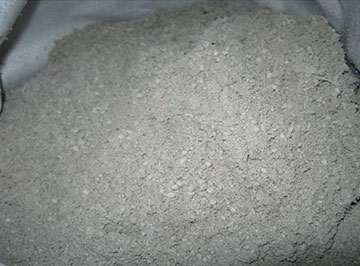
Dry mortar formulations contain particles with very different characteristics.
| Material | Particle Size |
|---|---|
| Quartz Sand | Large |
| Cement | Medium |
| HPMC | Fine |
| RDP | Ultra Fine |
Traditional mixers often struggle with these differences. Gravity-free mixers eliminate this problem through three-dimensional movement.
Reduced Material Segregation
Segregation occurs when heavy particles settle while lighter particles remain on top. The weightless mixing principle minimizes this phenomenon. As a result:
- Better product consistency
- More stable quality
- Reduced customer complaints
Improved Additive Distribution
Micro additives such as:
- HPMC
- Starch Ether
- RDP
- Pigments
typically account for less than 1% of the total formulation. Despite the small quantity, they greatly influence product performance. The gravity-free mixer ensures these additives are distributed evenly throughout the batch.
Key Components That Affect Mixing Performance
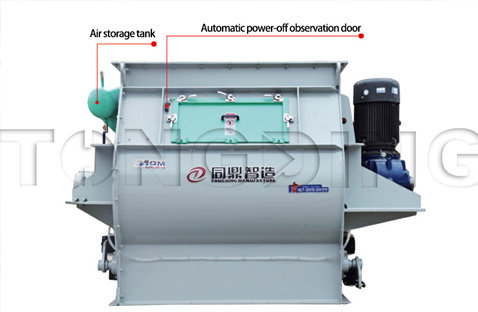
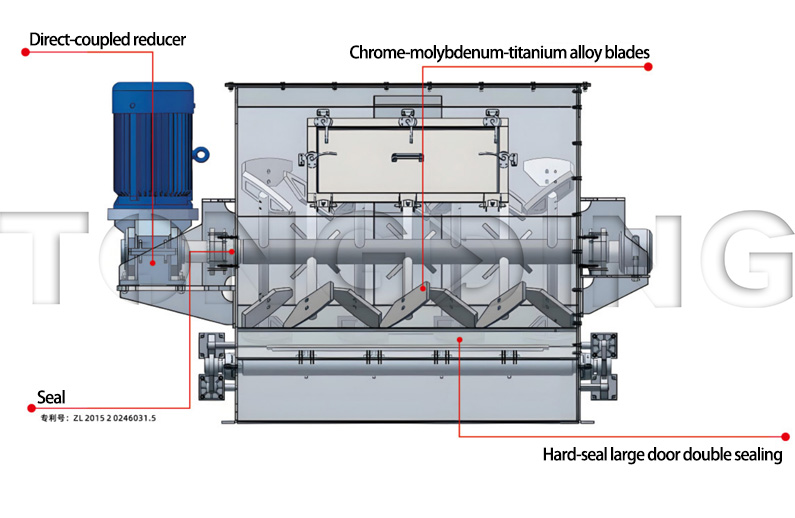
- Mixing Chamber – Provides sufficient space for material movement.
- Twin Shafts – Generate synchronized counter-rotation.
- Mixing Paddles – Create the weightless zone.
- Gearbox and Drive System – Deliver stable power transmission.
- Pneumatic Discharge Door – Ensures fast unloading and low residue.
- Dust Collection Interface – Supports closed and environmentally friendly production.
What Materials Can Be Mixed in a Double Shaft Gravity-Free Mixer?
The mixer is suitable for a wide variety of materials.
Construction Materials
- Dry Mortar
- Tile Adhesive
- Wall Putty
- Masonry Mortar
- Plaster Mortar
- Self-Leveling Mortar
Chemical Industry
- Pigments
- Detergent Powders
- Additives
- Polymer Powders
Industrial Materials
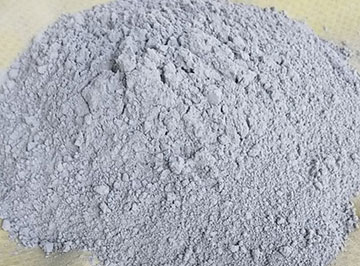
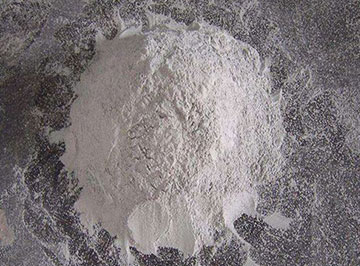
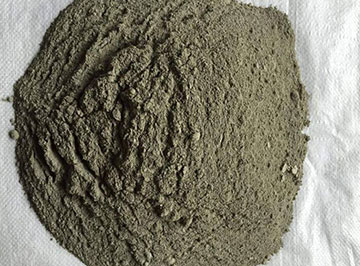
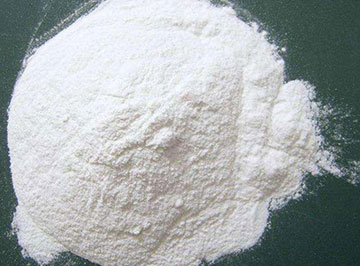
- Fly Ash
- Calcium Carbonate
- Silica Powder
- Refractory Materials
Related Reading:
What Materials Can Be Mixed in a Double Shaft Gravity-Free Mixer?
Common Problems That Affect Mixing Efficiency
Excessive Material Moisture
Wet materials can cause:
- Caking
- Reduced flowability
- Longer mixing times
For dry mortar production, sand moisture should generally remain below 0.5%.
Related Equipment:
Worn Mixing Paddles
Severely worn paddles reduce:
- Material circulation
- Mixing efficiency
- Uniformity
Regular inspection is recommended.
Incorrect Filling Ratio
Most gravity-free mixers achieve optimal performance at 40%-70% filling capacity. Overloading reduces mixing effectiveness.
Double Shaft Gravity-Free Mixer vs Ribbon Mixer
Compared with ribbon mixers, gravity-free mixers offer:
| Item | Gravity-Free Mixer | Ribbon Mixer |
|---|---|---|
| Mixing Uniformity | 99%+ | 90%-95% |
| Mixing Time | 3-5 min | 10-15 min |
| Segregation Risk | Very Low | Medium |
| Additive Distribution | Excellent | Moderate |
| Productivity | High | Medium |
Related Reading:
Double Shaft Gravity-Free Mixer vs Ribbon Mixer: Which Is Better for Dry Mortar Production?
Frequently Asked Questions
How long does one mixing cycle take?
Most batches require 3-5 minutes.
What mixing uniformity can be achieved?
Typically above 99%.
Can a gravity-free mixer process wet materials?
It is designed primarily for dry powder materials.
Is a gravity-free mixer suitable for tile adhesive production?
Yes. It is one of the most commonly used mixers in tile adhesive plants.
Does it require dried sand?
For high-quality dry mortar products, dried sand is strongly recommended.
Conclusion
The Double Shaft Gravity-Free Mixer has become the preferred mixing solution for modern dry mortar production lines due to its superior mixing efficiency, high uniformity, and ability to handle complex formulations.
By creating a temporary weightless mixing zone through synchronized counter-rotating shafts and specially designed paddles, the mixer achieves rapid and homogeneous blending that conventional mixers cannot easily match.
For manufacturers producing tile adhesive, wall putty, self-leveling mortar, or dry mix mortar, investing in a high-quality gravity-free mixer can significantly improve product quality, reduce production costs, and increase plant productivity.
Request a Free Mixing Solution
Looking for the right mixer for your production line?
Contact our engineering team today for:
- ✓ Capacity Recommendation
- ✓ Mixer Model Selection
- ✓ Production Line Design
- ✓ Technical Consultation
- ✓ Factory Direct Quotation