
Ploughshare Mixer vs Twin Shaft Paddle Mixer – Which Is Right for Your Dry Mortar Plant?
Ploughshare Mixer vs Twin Shaft Paddle Mixer
Tongding|A Detailed Comparison of Two High-Performance Mixing Technologies for Dry Mortar Production: Working Principles, Applications, Advantages and Selection Criteria
2. Ploughshare Mixer
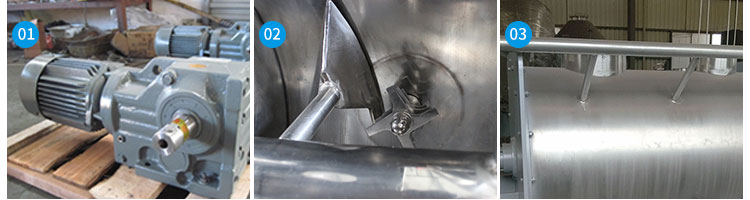
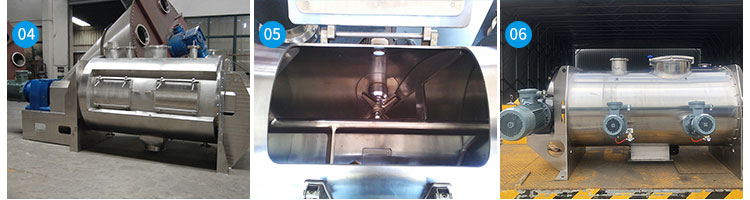
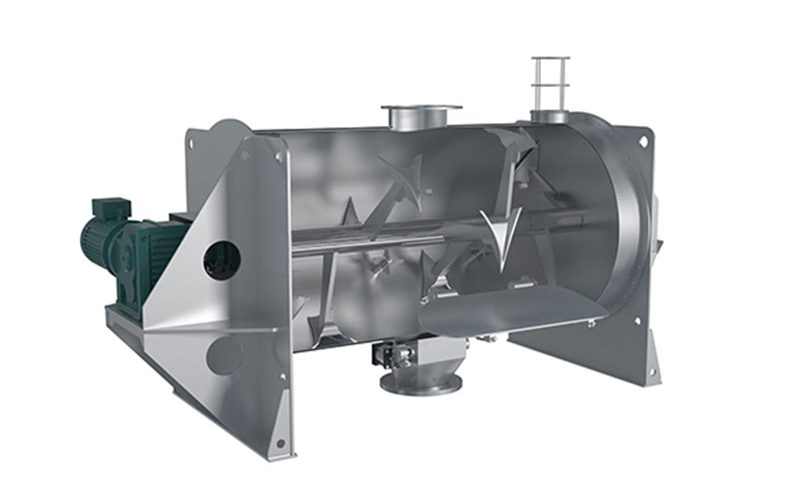
The Ploughshare Mixer, also known as a Plow Mixer, is widely used for manufacturing high-performance dry mortar products that require intensive mixing and excellent additive dispersion. Compared with a ribbon mixer, its unique plough-shaped mixing tools create a high-speed mechanical fluidized zone, allowing powders, fibers, pigments, and chemical additives to be distributed more evenly throughout the mixture.
Because many modern dry mortar formulations contain small quantities of polymer powders, cellulose ethers, starch ethers, pigments, and reinforcing fibers, a ploughshare mixer provides significant advantages for specialty construction materials where mixing precision directly affects product performance.
How a Ploughshare Mixer Works
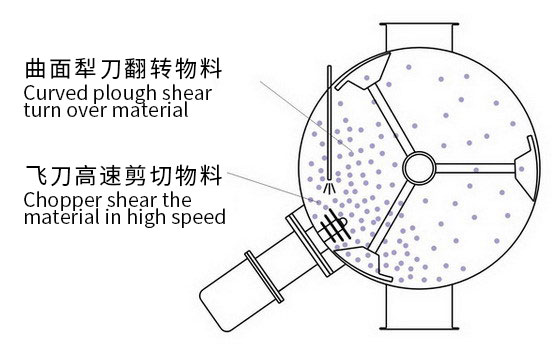
Inside the horizontal mixing chamber, multiple plough-shaped blades rotate at high speed along the main shaft. Instead of simply moving materials from one side to another, these blades continuously throw particles into free-flowing motion, creating a three-dimensional mixing process.
This fluidized mixing action allows each particle to collide repeatedly with surrounding materials, resulting in excellent dispersion of micro-additives and minimizing segregation.
Typical Applications
- Tile Adhesive
- EIFS Mortar
- Waterproof Mortar
- Self-Leveling Mortar
- Repair Mortar
- Decorative Mortar
- Modified Dry Mortar
Typical Production Capacity
- 400–600 kg per batch
- Continuous production available
- Suitable for medium-capacity production plants
Advantages of Ploughshare Mixers
- Excellent additive dispersion
- High shear mixing performance
- Suitable for sticky and lightweight materials
- Excellent mixing uniformity
- Ideal for premium dry mortar formulations
- Can be equipped with high-speed choppers for fiber dispersion
Limitations
- Higher equipment investment than ribbon mixers
- More wearing components require periodic replacement
- Higher power consumption
- Not the best choice for coarse aggregate materials
- Tile Adhesive Manufacturers
- Chemical Mortar Producers
- Premium Dry Mix Products
- Factories Requiring High Formula Accuracy
3. Twin Shaft Paddle Mixer
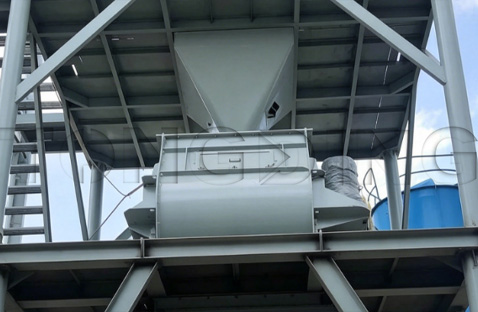
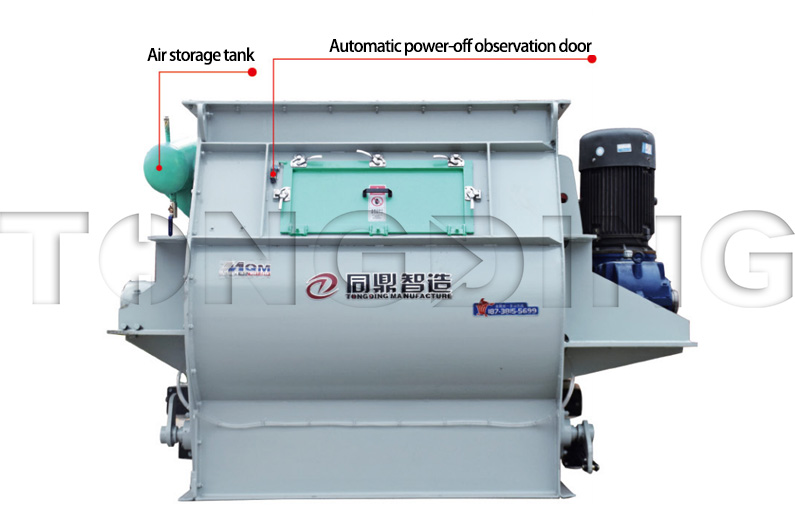
The Twin Shaft Paddle Mixer represents one of the most efficient mixing technologies used in modern fully automatic dry mortar production lines. Designed for continuous industrial production, it combines high-speed mixing, excellent uniformity, and large production capacity within a relatively short mixing cycle.
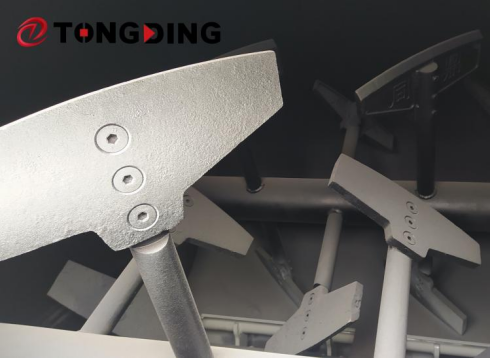
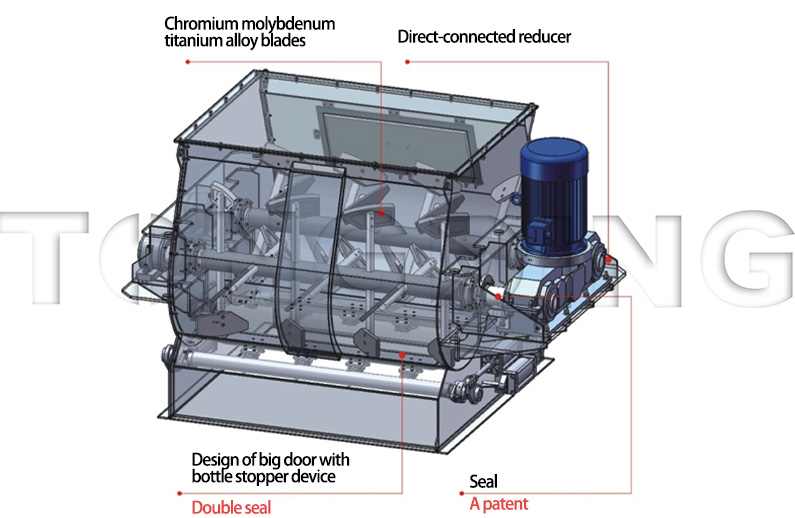
Instead of using ribbons or plough blades, two synchronized shafts equipped with multiple paddles rotate in opposite directions. This counter-rotating motion creates intensive convection and rapid particle circulation, ensuring every batch reaches a highly homogeneous state within only a few minutes.
Working Principle
Materials enter the mixing chamber through the feeding system. As the two paddle shafts rotate simultaneously, powders are lifted, scattered, and circulated in three dimensions. The counter-rotating design eliminates dead zones and significantly shortens the mixing cycle compared with conventional mixers.
Because of its outstanding efficiency, this mixer is commonly integrated into fully automatic dry mortar plants with continuous production requirements.
Typical Applications
- Large Dry Mortar Plants
- Tile Adhesive Production
- Self-Leveling Mortar
- Masonry Mortar
- Plastering Mortar
- Repair Mortar
- Industrial Dry Mix Products
Typical Production Capacity
- Approximately 1,000 kg per batch
- Mixing cycle: 3–5 minutes
- Continuous output: 10–15 TPH or higher
Advantages of Twin Shaft Paddle Mixers
- Extremely fast mixing speed
- Excellent mixing uniformity
- Suitable for continuous production
- High hourly output
- Excellent additive dispersion
- Ideal for automated production lines
- Stable operation under heavy workloads
Limitations
- Higher initial investment
- Larger installation space required
- More complex maintenance than ribbon mixers
- Recommended mainly for medium and large factories
- Large Construction Material Manufacturers
- Automatic Dry Mortar Plants
- Export-Oriented Production
- High-Capacity Industrial Manufacturing
Ribbon Mixer vs Ploughshare Mixer vs Twin Shaft Paddle Mixer
Selecting the right mixer depends on your production objectives rather than choosing the most expensive equipment. Investment budget, product type, production capacity, factory size, and future expansion plans should all be considered before making a decision.
| Comparison Item | Ribbon Mixer | Ploughshare Mixer | Twin Shaft Paddle Mixer |
|---|---|---|---|
| Mixing Principle | Counter-flow Ribbon | Fluidized Plough Blades | Dual Paddle Shafts |
| Mixing Time | 15–20 Minutes | 20–30 Minutes | 3–5 Minutes |
| Production Capacity | Small to Medium | Medium | Medium to Large |
| Mixing Uniformity | Good | Excellent | Excellent |
| Sticky Materials | Fair | Excellent | Excellent |
| Energy Consumption | Medium | Medium to High | High Efficiency |
| Equipment Cost | Low | Medium | High |
| Automation Level | Semi-Automatic | Automatic | Fully Automatic |
| Recommended Users | Startups | Specialty Mortar Producers | Large Manufacturers |
How to Choose the Right Mixer for Your Dry Mortar Plant
There is no universally “best” mixer. The ideal solution depends on your production requirements, investment budget, product portfolio, and long-term business strategy. Understanding your current needs and future expansion plans will help you select equipment that delivers the highest return on investment.
Choose a Ribbon Mixer If…
- Your investment budget is limited.
- You are starting a new dry mortar business.
- You mainly produce masonry mortar or wall putty.
- You need reliable equipment with simple maintenance.
Choose a Ploughshare Mixer If…
- You manufacture premium tile adhesive.
- Your products contain polymers or fibers.
- You require excellent additive dispersion.
- You focus on specialty construction materials.
Choose a Twin Shaft Paddle Mixer If…
- You operate a fully automatic production line.
- You require continuous high-capacity production.
- You plan long-term factory expansion.
- You supply large construction projects or export markets.
For most new investors, equipment selection should not be based solely on production capacity. Raw materials, mortar formulations, local labor costs, factory layout, future expansion plans, and target markets should all be evaluated before selecting the most suitable mixer. A properly matched production line can significantly improve production efficiency while reducing long-term operating costs.
For a deeper comparison of the Ploughshare Mixer and the Twin Shaft Paddle Mixer—including working principles, production performance, suitable materials, and investment considerations—please read our detailed guide: Applications of Different Dry Mortar Mixers – Complete Selection Guide