
Single Pass vs. Triple Pass Rotary Dryer: Which is Best for Sticky Minerals and Slurry?
Single Pass vs. Triple Pass Rotary Dryer: Which Is Best for Sticky Minerals & Slurry?
Structural differences, clogging risks, thermal efficiency and OPEX compared for mineral processing plants
Industrial drying lines form the backbones of modern mineral processing, mining, and refractory aggregate plants. However, selecting the wrong drum configuration can devastate your operational margins through catastrophic clogging, thermal inefficiency, or premature component wear.
When configuring a production plant, the primary engineering choice comes down to a Single Pass (Single Shell) Rotary Dryer versus a Triple Pass (Triple Cylinder) Rotary Dryer. While both use rotary drum mechanics, they operate under completely different fluid dynamics and thermal laws.
This technical guide breaks down the structural differences, material compatibility, and engineering metrics to help you select the most profitable system for your mineral processing facility.
Technical Comparison Guide | Single Pass vs. Triple Pass1. Understanding the Structural Differences
To evaluate these systems, plant managers must understand how material and hot air streams interact within the respective drum geometries.
What Is a Single Shell (Single Pass) Rotary Drum Dryer?
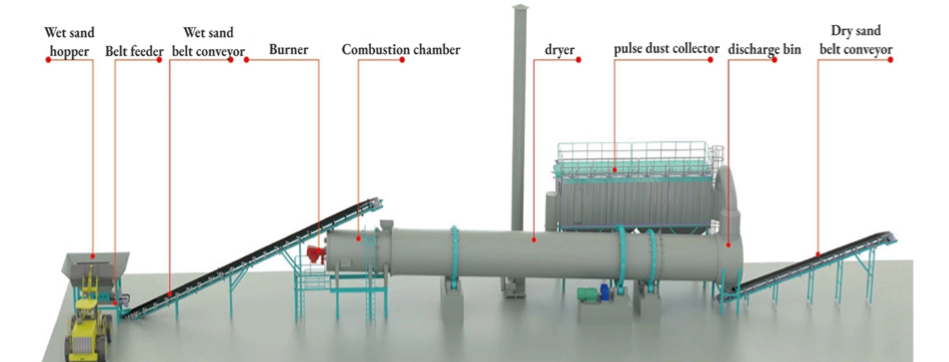
A Single Pass Rotary Dryer consists of a single, continuous elongated horizontal steel cylinder mounted on riding rings and driven by a girth gear system. Material enters at the higher feed terminal and travels down the entire length of the tube.
This architecture allows for a massive, unobstructed interior volume, providing extended retention times (1–9 r/min adjustability) and unhindered movement for bulk elements.
How Does a Three-Return (Triple Pass) Cylinder Dryer Work?
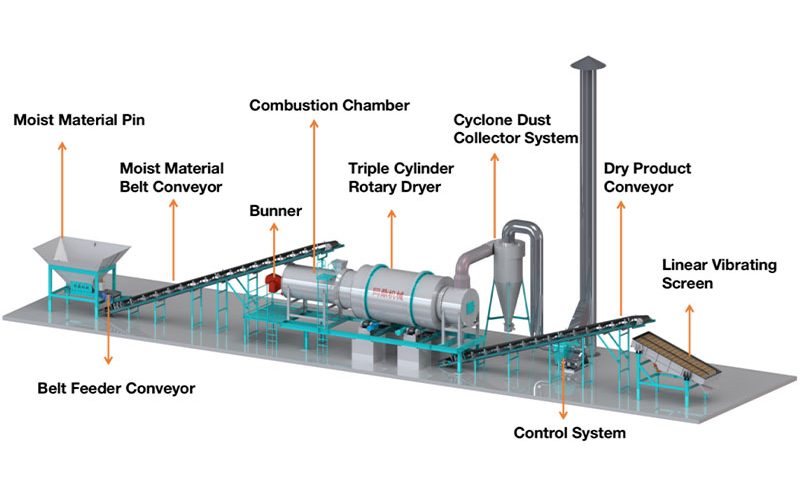
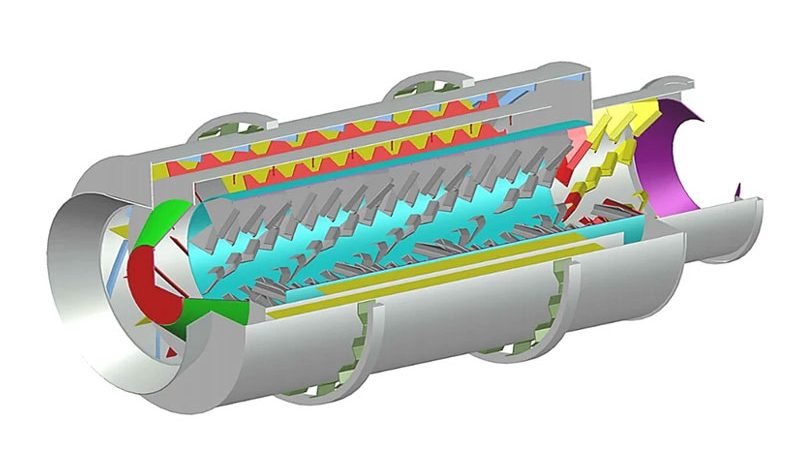
A Triple Pass Rotary Dryer features three concentric cylinders nested inside one another. The material and hot flue gas do not travel in a single straight line. Instead, they execute a zigzag thermal path:
- Material enters the internal cylinder (first pass), absorbing high-temperature flash heat.
- It reverses direction into the middle cylinder (second pass), utilizing residual heat.
- It reverses again into the external cylinder (third pass) for final moisture balancing before discharge.
While this design drastically minimizes the equipment’s physical footprint and captures radiation losses efficiently, the internal spaces and turning channels are significantly restricted.
2. The Fatal Clogging Nightmare: Why Triple Pass Dryers Fail with Sticky Slurry and Clay
Triple pass dryers are highly efficient for free-flowing materials. However, pushing sticky minerals or heavy slurries through a concentric nested system leads to immediate process failure.
Internal Interlocking: How High-Viscosity Materials Trap Inside Nested Drums
High-viscosity raw materials — such as coal slurry, industrial sludge, filter cakes, bentonite, and soft clay — exhibit extreme surface adhesion when damp.
As these minerals lose moisture in the internal cylinder, they reach a transition state known as the “sticky phase.” In a triple pass system, when the material cascades into the turning chambers to enter the middle cylinder, it adheres to the internal walls and tight turning baffles.
Because the nested cylinders cannot be accessed mechanically from the outside, the sticky mineral quickly bakes into a hard cake, narrowing the channel until a complete structural blockage occurs.
Moisture Evacuation Bottlenecks in Triple-Pass Airflow
Heavy slurries release large volumes of high-humidity vapor rapidly. In a triple pass dryer, this vapor must travel through the same tortuous, winding path as the material. The elevated moisture creates a localized heavy dew-point inside the middle and outer shells. Vapor condenses back onto the semi-dried fine powder, causing it to ball up into large, dense agglomerates. This mud-balling effect creates an airflow bottleneck, destabilizing the system’s negative pressure and collapsing the heat exchange efficiency.
3. Why Single Pass Long Tube Dryers Excel in Heavy, High-Moisture Mining Applications
For high-viscosity ores and high-moisture slurries, a Single Shell Long Tube Dryer is the industry standard. Its straight-through, spacious single-drum geometry allows for aggressive mechanical interventions that keep sticky materials moving continuously.
Phase-Adaptive Lifting Flights: Combining Breaker Plates and Shoveling Boards
Advanced long tube systems utilize a Multi-Structural Combined Flight System to handle materials as they change states along the drum length:
- Inlet Zone: Heavy breaker/crusher plates rip apart large, damp mud cakes and maximize exposed surface area for hot air penetration.
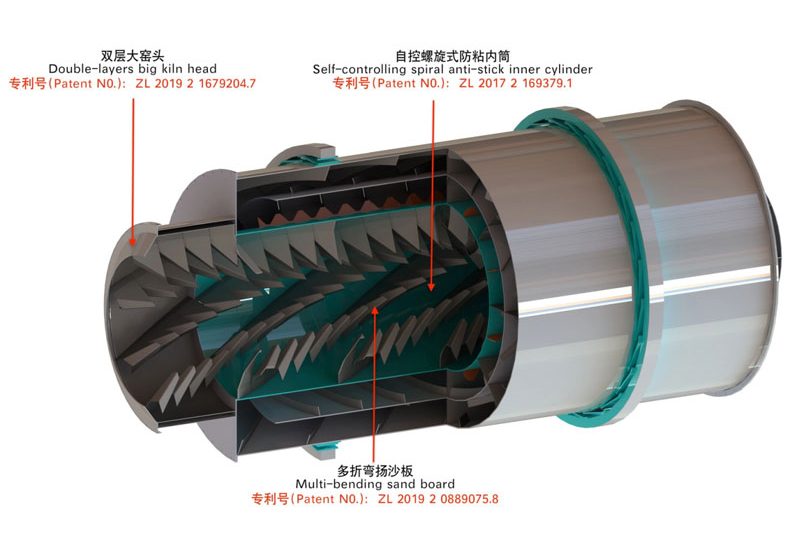
- Middle Drying Zone: Patented multi-bending flights (Patent ZL201920889075.8) scoop the material and shower it in a uniform cascading veil from the 2 o’clock to the 10 o’clock positions, ensuring zero thermal dead zones.
- Discharge Zone: Standard shoveling plates ensure uniform, steady delivery to the discharge bin.
This phase-adaptive layout effortlessly processes feed materials with moisture ranges from 5% up to 30%, guaranteeing a final moisture homogeneity deviation of within ≤1%.
Mechanical Defenses: Gravity Steel-Ball Knockers and Clearing Chains
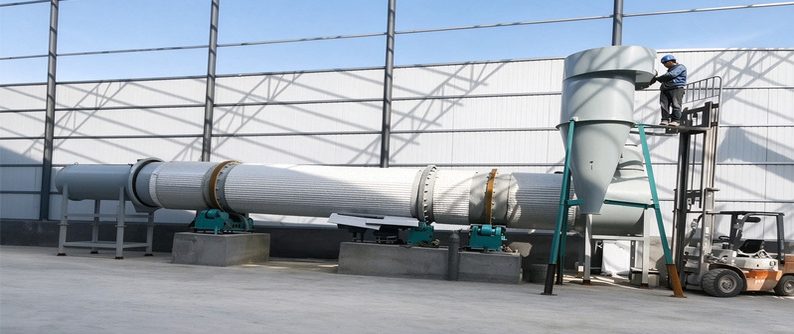
Single shell dryers allow for external and internal physical cleaning mechanisms that are impossible to mount on triple-shell designs.
- Internal clearing chains: Fitted on internal flights to scrape steel surfaces dynamically as the drum rotates.
- Gravity steel-ball knockers: Multiple rings of vertical gravity steel-ball knockers mounted externally. As the drum revolves, these steel balls exert high-impact perpendicular vibration directly through the shell, knocking loose lingering inner mud layers before they can bake hard.
This dual-layer defense reduces internal wall scaling by over 85%, drastically slashing manual maintenance intervals.
4. Thermal Efficiency vs. Mechanical Stability: Weighing the OPEX
While triple pass systems are celebrated for low thermal radiation losses from their outer shells, modern single-pass engineering has closed the efficiency gap while delivering superior mechanical reliability.
Eliminating Axial Hunting: Zero-Horizontal-Thrust Driving Design
The massive length and weight of single-shell dryers (often spanning 24 to 40 meters) traditionally exerted extreme axial forces on trunnion rollers. This horizontal thrust causes rapid roller wear, structural hunting, and massive power draw.
Advanced manufacturers now use a Zero-Horizontal-Thrust Direct Under-Drive Design. By precisely engineering the support angles of the trunnion rollers and aligning the primary girth gear directly beneath the drum’s vertical center line (keeping deviation within ≤5mm), the horizontal forces cancel out completely.
This structural breakthrough drops equipment operating current dramatically, reducing drive power consumption by more than 30%. For example, a heavy 30 TPH processing line that traditionally requires a 30kW motor can operate smoothly on a 20–22kW drive, while drum axial stability is enhanced by 40%.
Minimizing Air Leakage with Fish-Scale and Counterweight Seals
Cold air infiltration is the primary driver of thermal degradation in single-shell systems. Modern systems counteract this with a dual-locking airtight system:
- Floating Stainless-Steel Fish-Scale Seals: Flexible 0.5–1mm overlapping stainless-steel plates at drum intersections maintain a tight elastic seal despite continuous thermal expansion, preventing over 90% of cold ambient air infiltration.
- Counterweight Flap Valve Airtight Discharge Bins (Patent ZL201811513639.4): The discharge terminal uses a mechanical counterweight flap valve that seals tightly against the exit chute. It opens automatically via material weight to dump dry sand but stays hermetically closed against the negative pressure of the induced draft system.
This comprehensive sealing system restricts system radiation and leakage losses to a minimal 3% to 5%.
5. Technical Decision Matrix: Choosing the Right Dryer for Your Plant
Use this direct technical matrix to map your raw material profiles to the correct drying technology.
| Material Profile | Recommended Dryer | Reason |
|---|---|---|
| Free-flowing sand, aggregate, minerals | Triple Pass Dryer | Compact footprint, low radiation loss, efficient for non-sticky materials |
| Coal slurry, sludge, filter cake | Single Pass Long Tube Dryer | Straight-through geometry prevents clogging in sticky phase |
| Bentonite, soft clay, high-viscosity minerals | Single Pass Long Tube Dryer | Breaker plates and clearing chains handle wall adhesion |
| High-moisture feed (20–30%) | Single Pass Long Tube Dryer | Extended retention time and large interior volume |
| Limited floor space, standard minerals | Triple Pass Dryer | Concentric design reduces footprint by up to 60% |
| High capacity with free-flowing material | Triple Pass Dryer | Efficient heat recovery across three passes |
Not Sure Which Dryer Fits Your Material?
Tell us your material type, feed moisture, target moisture and required capacity. Our engineers will review the operating conditions and recommend a suitable drum configuration.
Please provide:
Material type
Feed moisture content
Target final moisture
Required capacity (TPH)
Available heat source
Installation country and site conditions
* Free equipment selection report, customized layout drawing, and budget estimate within 24 hours