
Complete Tile Adhesive Manufacturing Process(二)
Complete Tile Adhesive Manufacturing Process (二)
Modern tile adhesive is manufactured through a fully automated production process that combines raw material preparation, precision batching, high-efficiency mixing, intelligent packaging, and PLC-controlled automation.
Unlike traditional manual production, a modern Tile Adhesive Production Line ensures every batch maintains consistent quality, accurate formulation, and stable production efficiency. Whether you are producing C1 tile adhesive, C2 flexible tile adhesive, or polymer-modified dry mortar, every production step directly influences the final product performance.
The complete manufacturing workflow can be divided into eight key stages.
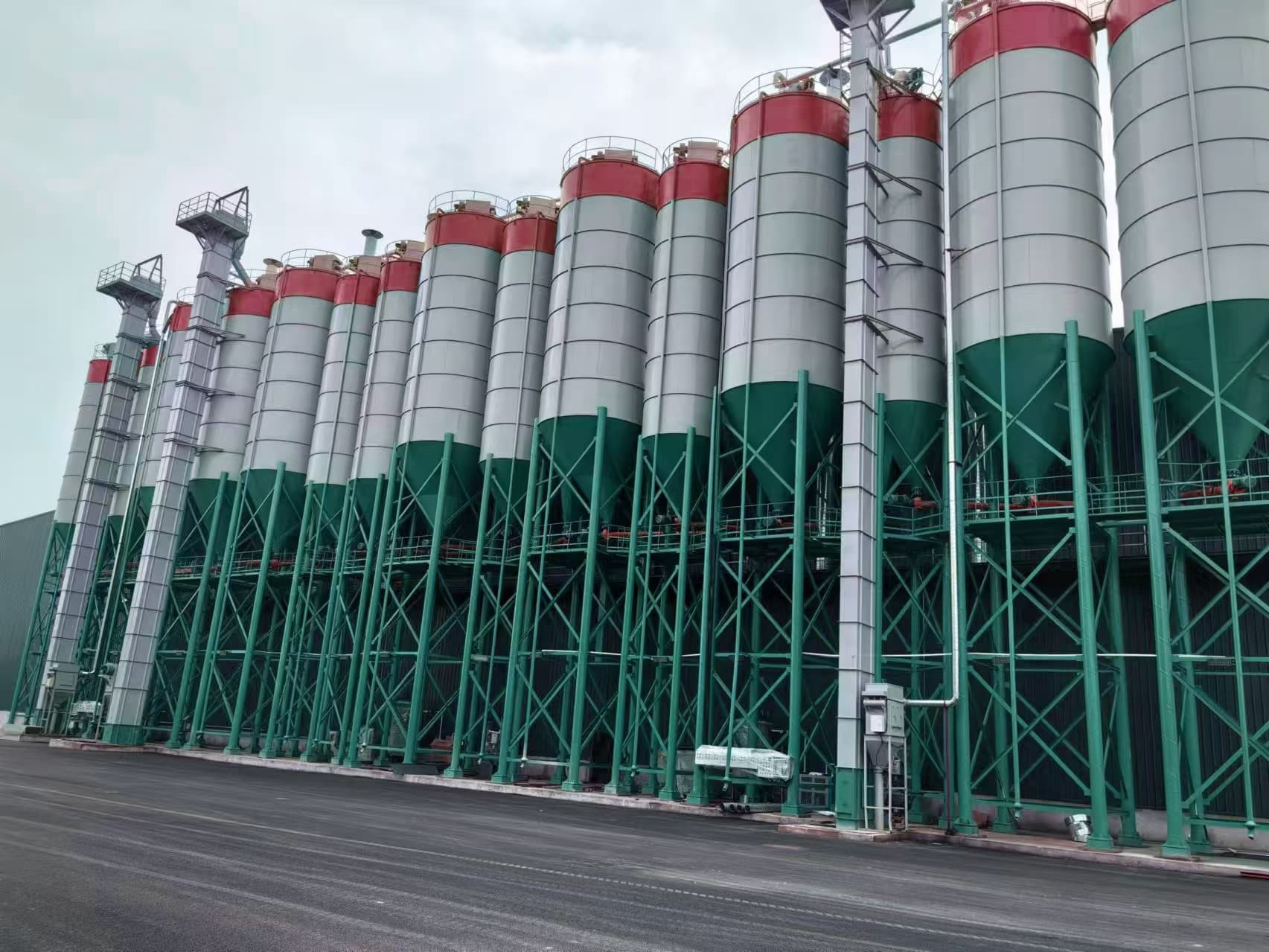
Step 1 – Raw Material Preparation
High-quality raw materials are the foundation of high-performance tile adhesive.
The performance of tile adhesive depends not only on the production equipment but also on selecting suitable raw materials and maintaining consistent quality throughout production.
A standard tile adhesive formulation generally includes:
- Dry sand (River Sand / Quartz Sand / Silica Sand)
- Ordinary Portland Cement (OPC)
- Calcium Carbonate Powder
- Fly Ash (optional)
- Gypsum Powder
- Cellulose Ether (HPMC)
- Redispersible Polymer Powder (RDP)
- Starch Ether
- Other Functional Additives
Each material performs a specific function.
Sand
Sand serves as the primary filler material and significantly affects workability, compressive strength, and bonding performance.
Common sand types include:
- River Sand
- Quartz Sand
- Silica Sand
- Manufactured Sand
Among them, washed and dried silica sand is widely used for premium tile adhesive because of its uniform particle size and low impurity content.
Cement
Portland cement provides the hydraulic strength required for bonding ceramic tiles, porcelain tiles, natural stone, and concrete substrates.
Different cement grades can be selected according to local standards and customer requirements.
Functional Additives
Although additives account for only a small percentage of the formula, they have a major impact on product performance.
Typical additives include:
- HPMC for water retention
- RDP for flexibility and adhesion
- Starch Ether for workability
- Anti-cracking additives
- Retarders and accelerators
Modern production lines use dedicated micro-additive dosing systems to ensure dosing accuracy reaches ±0.1%, preventing formula deviation and ensuring consistent product quality.
Many buyers focus only on production capacity when purchasing equipment. However, raw material quality often determines whether the final product can meet international standards.
Using stable raw materials helps manufacturers achieve:
- Higher bonding strength
- Better open time
- Improved anti-slip performance
- Consistent setting time
- Lower production waste
This is why professional manufacturers pay equal attention to both equipment selection and raw material management.
Step 2 – Sand Drying Process
One of the most important stages in tile adhesive manufacturing is reducing the moisture content of sand.
Fresh river sand usually contains 5–20% moisture, while high-quality tile adhesive typically requires sand moisture below 0.5%.
Excessive moisture can cause:
- Formula deviation
- Poor mixing performance
- Material agglomeration
- Inaccurate additive dosing
- Reduced product stability
- Shorter storage life
For this reason, most industrial factories install a dedicated Rotary Sand Dryer before the batching system.
How a Rotary Sand Dryer Works
- Wet sand is continuously fed into the dryer by a belt conveyor.
- Inside the rotating drum, specially designed lifting plates continuously lift and scatter the sand, creating a uniform material curtain.
- At the same time, the burner generates high-temperature airflow that passes through the drum and rapidly evaporates moisture.
- The dried sand is then discharged and transported to the screening system.
Modern Triple Cylinder Rotary Sand Dryers offer several advantages:
- Heat efficiency above 90%
- Lower fuel consumption
- Compact footprint
- Stable outlet moisture
- Continuous operation
- Easy maintenance
These systems are widely used in:
- Tile Adhesive Manufacturing Plants
- Dry Mortar Production Lines
- Wall Putty Production
- Quartz Sand Drying
- Foundry Sand Processing
Choosing the Right Heat Source
Different countries have different fuel costs and environmental requirements.
Common burner options include:
- Natural Gas Burner
- Diesel Burner
- Biomass Burner
- Coal Burner (where permitted)
Tongding customizes burner selection according to local energy prices, helping customers reduce long-term operating costs.
Step 3 – Sand Screening and Storage
After drying, the sand enters the screening system.
The purpose of screening is to ensure every particle meets the required size distribution.
Common mesh sizes depend on the product being manufactured.
Oversized particles are automatically separated, while qualified material is transported to the finished sand storage silo.
Proper screening provides several advantages:
- Uniform particle grading
- Better workability
- Improved mixing efficiency
- Higher product consistency
- Reduced wear on downstream equipment
The dried sand is then stored in enclosed silos, preventing moisture absorption before production begins.
Step 4 – Automatic Batching System
Accurate batching is one of the most critical steps in tile adhesive production.
Every raw material must be weighed according to the production formula before entering the mixer.
Modern production lines use a fully automatic PLC-controlled batching system that precisely measures:
- Sand
- Cement
- Calcium Carbonate
- Fly Ash
- Gypsum Powder
The weighing system automatically adjusts according to the selected recipe, ensuring every batch follows the same formulation.
Compared with manual weighing, automatic batching provides:
- Higher accuracy
- Faster production
- Reduced labor
- Better repeatability
- Lower material waste
This is especially important for manufacturers producing multiple products on one production line.
Step 5 – Micro Additive Dosing
Although additives represent less than 5% of the total formula, they determine the final performance of tile adhesive.
For this reason, professional production lines are equipped with dedicated micro-dosing systems.
These systems accurately feed:
- HPMC
- RDP
- Starch Ether
- Cellulose Ether
- Functional Chemical Additives
The dosing accuracy can reach ±0.1%, ensuring every batch maintains identical performance.
A reliable micro-dosing system helps manufacturers achieve:
- Stable bonding strength
- Consistent open time
- Better flexibility
- Improved water retention
- Reduced customer complaints
Step 6 – High-Efficiency Mixing
Once all materials have been accurately weighed, they enter the mixing system.
Most modern tile adhesive factories use a Twin Shaft Gravity-Free Paddle Mixer, also known as a Non-Gravity Double Shaft Paddle Mixer.
Unlike traditional ribbon mixers, this design creates a fluidized mixing zone where materials are suspended in the air rather than compressed.
This results in:
- Mixing uniformity above 99%
- Faster mixing cycles
- Better additive dispersion
- Lower residue
- Reduced cleaning time
Typical mixing time ranges from 3 to 5 minutes, depending on product formulation and capacity.
Because the additives are evenly distributed throughout the material, the finished tile adhesive achieves consistent performance in every bag.
Step 7 – Automatic Packaging
After mixing, the finished product enters the storage hopper before being transferred to the packaging system.
Packaging solutions can be selected according to customer requirements. Common options include:
- Valve Bag Packing Machine
- Open Mouth Bag Packing Machine
- Jumbo Bag Filling Machine
- Bulk Loading System
For tile adhesive, 25 kg valve bags are the most widely used packaging format.
Modern automatic packing systems provide:
- High weighing accuracy
- Fast filling speed
- Low dust emission
- Reduced labor costs
- Stable bag appearance
Optional robotic palletizing systems can automatically stack finished bags onto pallets, further improving production efficiency.
Step 8 – Finished Product Storage and Delivery
After packaging, finished products are conveyed to the warehouse or palletizing area.
Proper storage protects the product from moisture and contamination before delivery.
Manufacturers typically arrange products according to:
- Product type
- Production batch
- Manufacturing date
- Customer order
An integrated warehouse management system also improves inventory control and shipment efficiency.
Once packaged and stored, the tile adhesive is ready for transportation to construction sites, distributors, and building material suppliers around the world.
Why Process Control Matters
Every production stage is closely connected. A small error in moisture control, batching accuracy, additive dosing, or mixing uniformity can affect the final quality of the product.
For this reason, leading manufacturers increasingly choose fully automatic tile adhesive production lines with PLC control systems. Automated process control not only improves consistency but also reduces labor costs, minimizes material waste, and ensures reliable long-term operation.
Whether you are building a 5 TPH startup plant, a 20 TPH automatic tile adhesive factory, or a 100 TPH turnkey dry mortar production line, understanding each manufacturing step helps you select the right equipment configuration and achieve stable, high-quality production.