Main Equipment Configuration of a Tile Adhesive Production Line
Main Equipment Configuration of a Tile Adhesive Production Line
A modern Tile Adhesive Production Line is much more than a single mixer or packing machine. It is a fully integrated manufacturing system where each piece of equipment performs a specific task to ensure continuous production, stable product quality, and maximum operating efficiency.
The equipment configuration can be customized according to:
- Production capacity (5–100+ TPH)
- Product types (C1, C2, C2TE, Wall Putty, Skim Coat)
- Raw material characteristics
- Factory layout
- Automation level
- Investment budget
A typical automatic tile adhesive manufacturing plant consists of the following core systems.
1. Rotary Sand Dryer
Function: Remove moisture from raw sand before production.
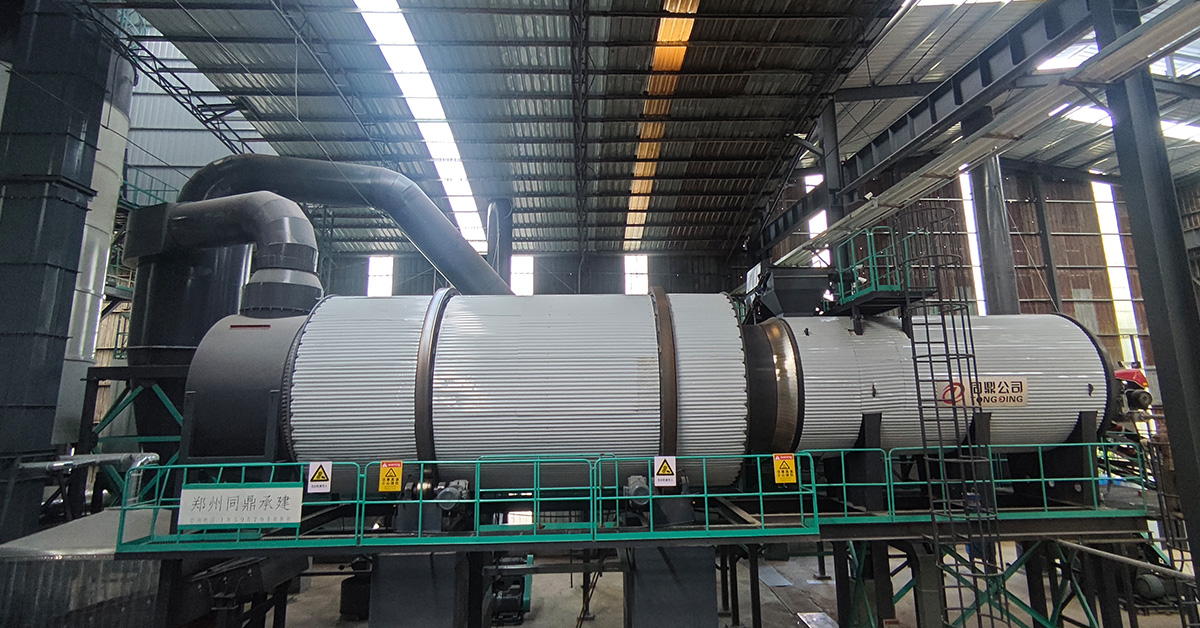
Raw sand is the largest component in tile adhesive production. However, freshly mined river sand or manufactured sand often contains 5–20% moisture, which can negatively affect batching accuracy, mixing uniformity, and final product quality.
A Rotary Sand Dryer reduces the moisture content to below 0.5%, creating the ideal condition for high-performance dry mix mortar production.
Main Advantages
- Stable outlet moisture
- High thermal efficiency
- Continuous production
- Low fuel consumption
- Easy maintenance
- Suitable for multiple fuel types
Optional Heat Sources
- Natural Gas
- Diesel
- Biomass
- Coal (where permitted)
Recommended Applications
- Tile Adhesive
- Wall Putty
- Skim Coat
- Dry Mortar
- Quartz Sand
- Silica Sand
- River Sand
Many customers ask: Can I produce tile adhesive without drying the sand?
Technically yes, but the product quality becomes unstable.
Wet sand causes:
- Formula deviation
- Poor additive distribution
- Lower bonding strength
- Material agglomeration
- Shorter storage life
For this reason, professional manufacturers almost always install a sand drying system.
Related Products
👉 Rotary Sand Dryer | 👉 Triple Cylinder Sand Dryer
2. Vibrating Screening Machine
Function: Classify dried sand into uniform particle sizes.
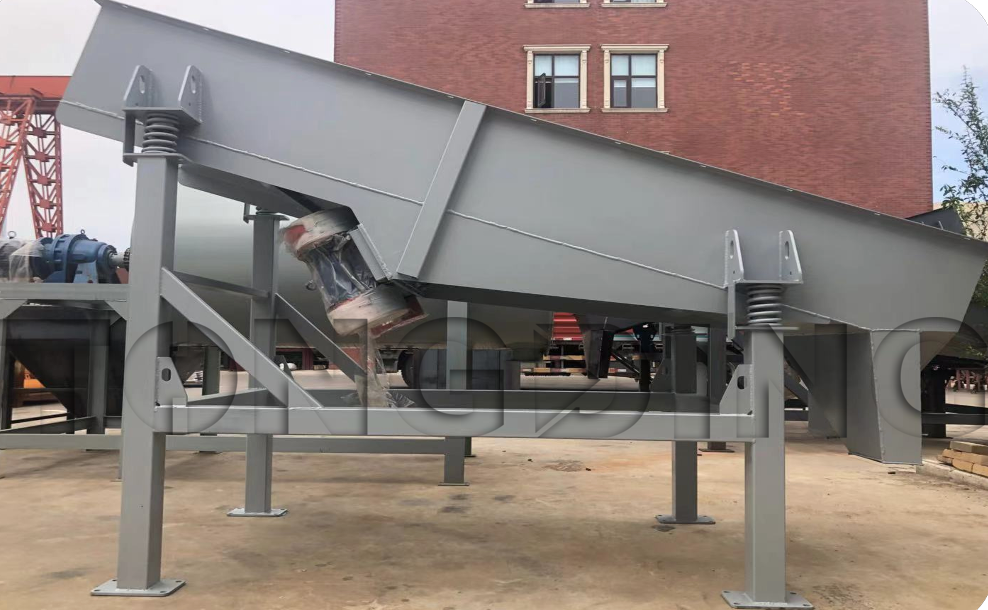
After drying, sand enters the screening machine to remove oversized particles and ensure consistent grading.
Uniform particle distribution improves:
- Mixing efficiency
- Finished product consistency
- Construction performance
- Adhesion strength
Most tile adhesive manufacturers select screen sizes according to local market standards.
Advantages
- High screening efficiency
- Stable particle size
- Low maintenance
- Continuous operation
3. Raw Material Storage Silos
Function: Store raw materials and ensure continuous production.
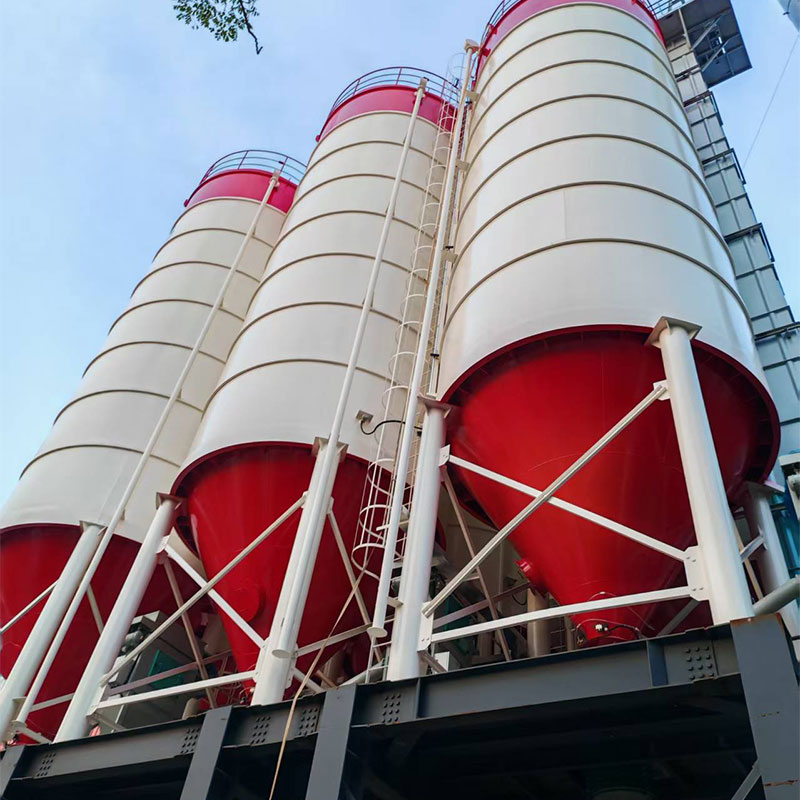
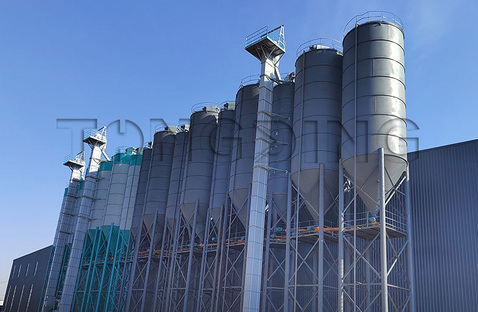
Storage silos provide a stable supply of materials to the batching system.
Typical materials stored include:
- Cement
- Dry Sand
- Fly Ash
- Calcium Carbonate
- Gypsum Powder
Depending on project requirements, silos are available in:
- 60T
- 100T
- 150T
- 200T
- 300T
Advantages
- Stable feeding
- Moisture protection
- Lower labor requirements
- Continuous production
4. Automatic Batching System
Function: Accurately weigh each raw material.
Batching is the “brain” of production accuracy.
Every ingredient is automatically weighed according to the selected production formula.
The system controls:
- Sand
- Cement
- Fly Ash
- Calcium Carbonate
- Gypsum
Automatic batching eliminates human error and ensures every production batch follows the same formulation.
Customer Benefits
- ✔ Higher product consistency
- ✔ Less raw material waste
- ✔ Faster production
- ✔ Lower labor cost
5. Micro Additive Dosing System
Function: Precisely feed chemical additives.
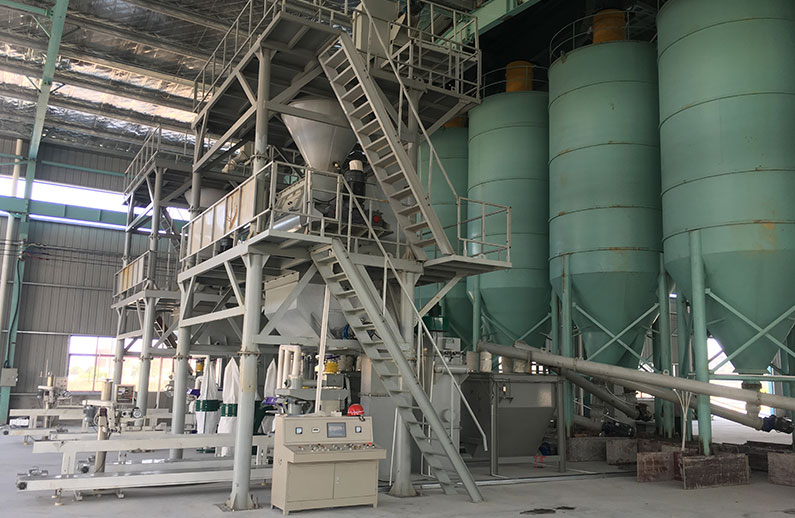
Although additives represent only a small percentage of the total formula, they determine most of the finished product performance.
Typical additives include:
- HPMC
- RDP
- Cellulose Ether
- Starch Ether
- Water Retention Agent
- Anti-Cracking Additives
The dosing accuracy reaches ±0.1%, ensuring every bag meets the required formulation.
Poor dosing accuracy may result in:
- Reduced bonding strength
- Poor workability
- Shorter open time
- Lower water retention
- Customer complaints
6. Twin Shaft Paddle Mixer
Function: Mix all raw materials into a homogeneous product.
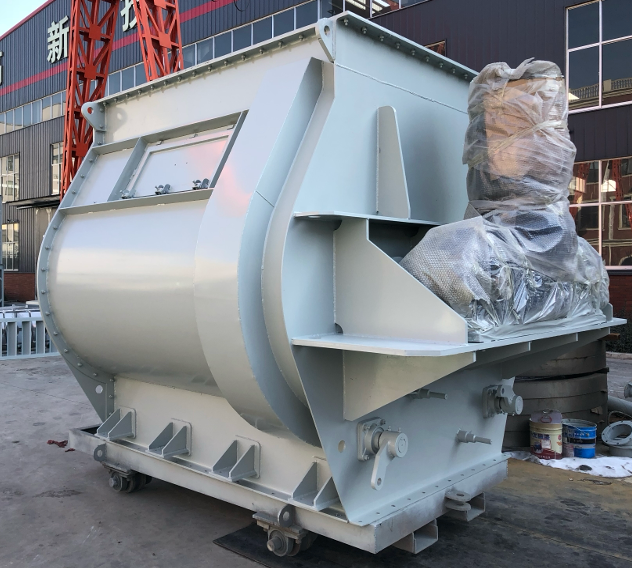
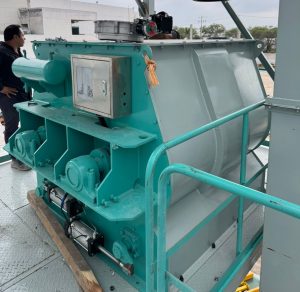
The mixer is the core machine of the entire production line.
Tongding uses a Non-Gravity Double Shaft Paddle Mixer, also known as a Twin Shaft Gravity-Free Mixer.
Unlike traditional ribbon mixers, this design creates a fluidized mixing zone where materials are suspended in the air and mixed rapidly.
Advantages
- Mixing Uniformity >99%
- Fast mixing cycle
- No dead corners
- Better additive dispersion
- Lower residue
- Easy cleaning
Typical mixing time: 3–5 minutes, depending on product formulation.
Products Suitable
- Tile Adhesive
- Wall Putty
- Self-Leveling Mortar
- Masonry Mortar
- Dry Mortar
- Gypsum Mortar
Related Product
7. Finished Product Hopper
Function: Temporary storage before packaging.
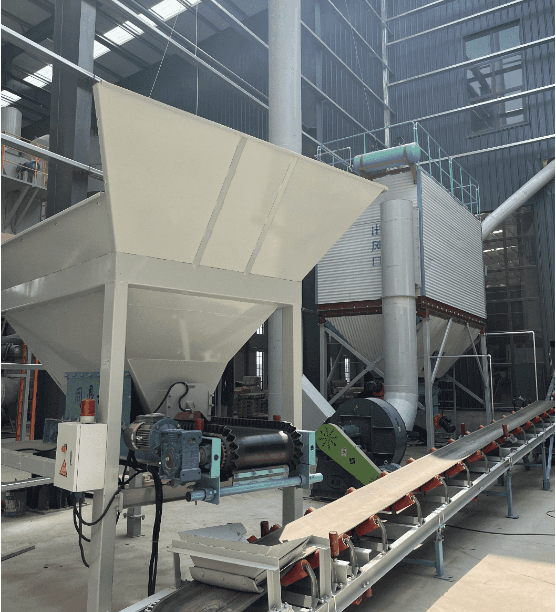
The hopper buffers production between mixing and packaging, allowing the mixer to continue operating while packaging proceeds independently.
This improves overall production efficiency and minimizes downtime.
8. Automatic Packing Machine
Function: Accurately fill finished products into bags.
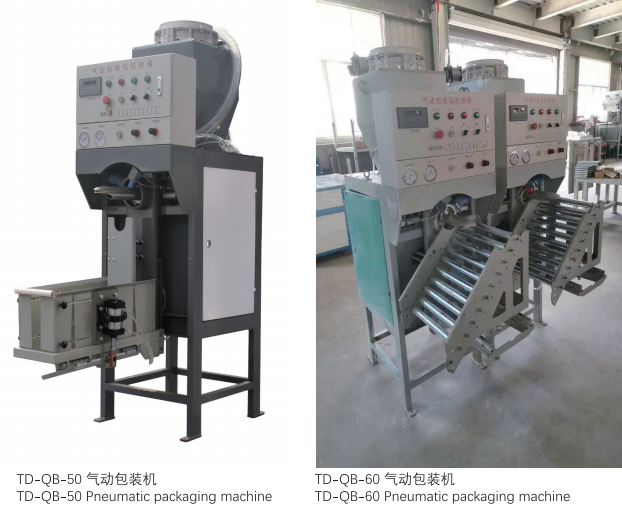
Packaging is the final stage before products are delivered to customers.
Tongding offers several packaging solutions:
- Valve Bag Packing Machine
- Air Float Packing Machine
- Air Blow Packing Machine
- Jumbo Bag Packing Machine
- Bulk Loading System
The most common configuration for tile adhesive is the 25 kg valve bag packing machine.
Advantages
- High weighing accuracy
- Fast packaging speed
- Low dust emission
- Stable bag appearance
- Reduced labor cost
Optional robotic palletizing systems can automatically stack finished bags, further increasing productivity.
Related Products
👉 Valve Bag Packing Machine | 👉 Jumbo Bag Packing Machine
9. PLC Intelligent Control System
Function: Control the entire production line.
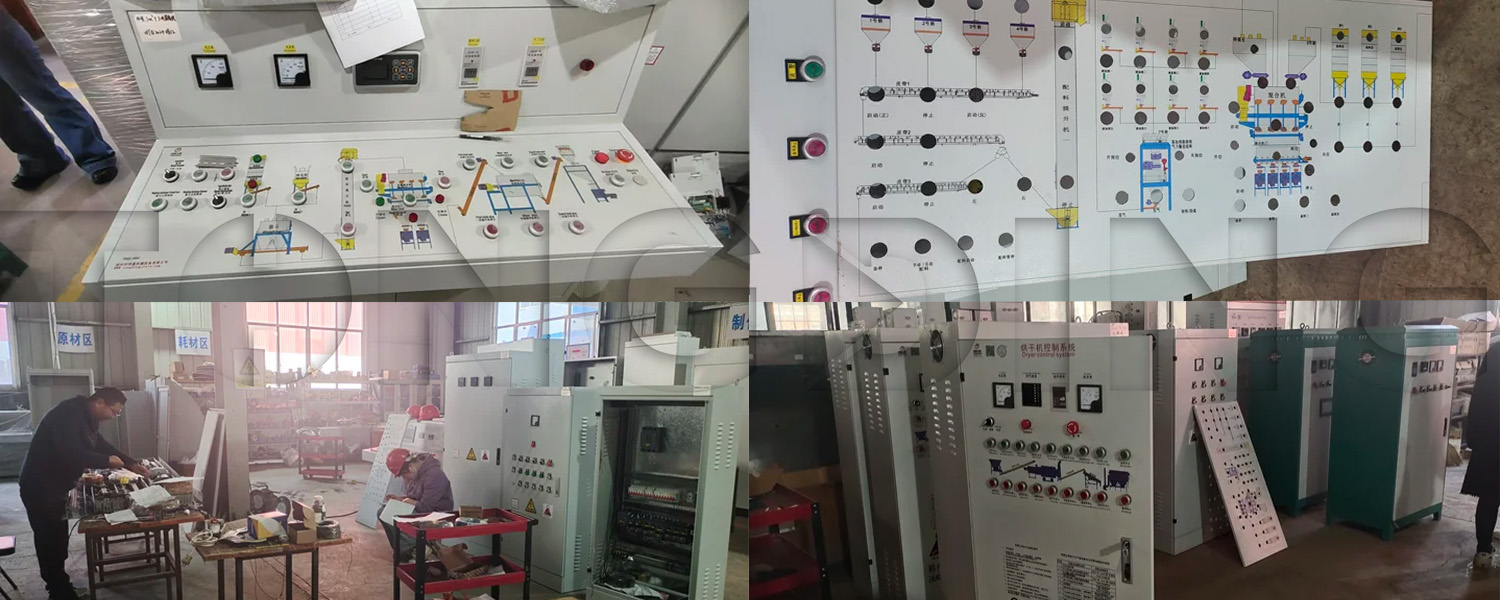
The PLC system coordinates every production stage through one centralized control interface.
Operators can manage:
- Formula selection
- Automatic batching
- Mixing time
- Packing speed
- Equipment monitoring
- Fault alarms
- Production statistics
Optional PLC brands include:
- Siemens
- Schneider
- Mitsubishi
- Delta
Advantages
- One-button startup
- Automatic production
- Lower labor cost
- Remote diagnostics
- Stable operation
- Recipe management
Equipment Configuration by Production Capacity
Different production capacities require different equipment configurations.
| Production Capacity | Typical Configuration |
|---|---|
| 5–10 TPH | Semi-automatic batching, twin shaft mixer, valve bag packing machine |
| 10–20 TPH | Fully automatic batching, rotary sand dryer, PLC control, automatic packing |
| 20–50 TPH | Multiple silos, automatic dosing, palletizing system, centralized PLC control |
| 50–100+ TPH | Tower-type plant, high-capacity dryer, multiple mixers, fully automated production |
This modular design allows manufacturers to expand production capacity as market demand grows without completely replacing the production line.
Why Equipment Selection Matters
Every machine in a tile adhesive production line directly influences product quality, production efficiency, and long-term operating costs.
Selecting the right equipment configuration can help manufacturers:
- Improve product consistency
- Reduce energy consumption
- Lower labor costs
- Increase production capacity
- Minimize maintenance requirements
- Achieve faster return on investment (ROI)
Rather than purchasing individual machines, many investors now choose a complete turnkey tile adhesive production line, where all equipment is engineered to work together as one integrated manufacturing system.
Internal Links (Recommended)
To improve understanding of each core machine, you can also explore:
External References
Additional industry standards and technical references available upon request.